
27 6 月 <br />
<b>Warning</b>:  Undefined variable $i in <b>/www/wwwroot/wordpress/wp-content/themes/land-excavator-pro/land-excavator-pro/template-parts/post/post-content.php</b> on line <b>57</b><br />
NBR O-Ring Advantages & Disadvantages | Silicone Sealing Mold Manufacturing
0 Comment
When manufacturing silicone seal molds and rubber sealing products, NBR O-rings remain the most widely used sealing element. Let’s break down the main advantages and limitations of nitrile rubber O-rings.

Advantages of NBR O-Rings

  1. NBR O-rings deliver outstanding resistance to water, solvents and mineral oil, plus excellent air tightness for hydraulic and plumbing systems.
  2. Nitrile rubber features great wear resistance and reliable compression set performance under long-term clamping pressure.

Disadvantages of NBR O-Rings

  1. NBR seals cannot work well in polar chemical environments. They degrade quickly when exposed to ozone, ketones and other strong polar media.

About Our Precision Mold Factory

Since establishment, Dongguan Ouning Precision has adhered to the principle of premium quality and customer-oriented service, following ISO quality standards to continuously optimize mold precision. Our mold manufacturing has earned consistent recognition from global buyers.
We are equipped with imported CNC machining centers (Taiwan Dali 1020 / 860), KENT grinders, EDM machines, and Miyano (BNA-42C) CNC lathes from Japan. We also adopt Mitutoyo testing instruments and professional design software including UG, PROE, MASTERCAM and CAD. We provide one-stop service from product development to finished rubber seal mold fabrication.
Our core business covers custom molds for 45° X-rings & O-rings, oil shaft seals, valve stem seals, as well as Y-type, U-type, K-type, O-type and X-type high-precision silicone rubber sealing components.
LEARN MORE
27 6 月 <br />
<b>Warning</b>:  Undefined variable $i in <b>/www/wwwroot/wordpress/wp-content/themes/land-excavator-pro/land-excavator-pro/template-parts/post/post-content.php</b> on line <b>57</b><br />
Silicone Rubber Seal Molds: Working Principle of Oil Seals
0 Comment

Working Principle of Rotary Shaft Oil Seals

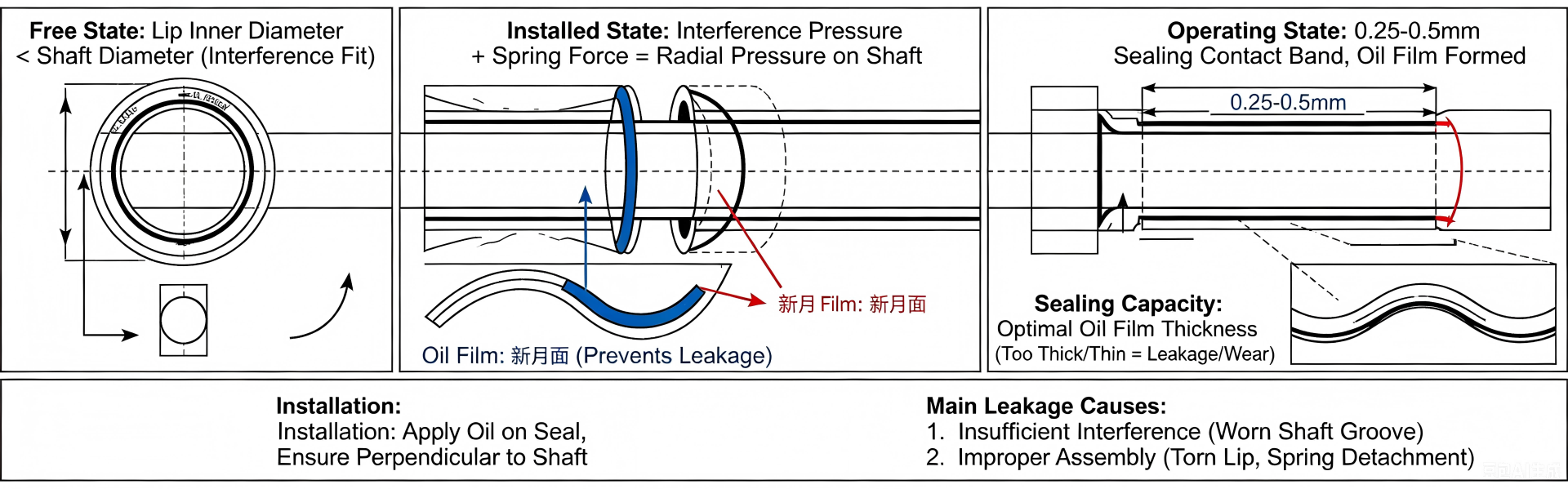
  1. In the free state, the inner diameter of the oil seal lip is smaller than the shaft diameter with a certain interference value.
  2. After installation, the interference pressure of the sealing edge together with the contraction force of the garter spring creates stable radial pressure against the rotating shaft.
  3. During operation, the lip forms a sealed contact band of 0.25~0.5 mm under radial compression. Under lubricant pressure, a thin oil film penetrates between the seal lip and the shaft. Guided by liquid surface tension, a crescent-shaped oil surface forms at the outer edge to block oil leakage and achieve effective sealing.
A precisely controlled oil film exists between the oil seal and shaft, which provides hydrodynamic lubrication. Relying on surface tension, the oil film forms a tight crescent boundary where liquid meets air and stops medium leakage for rotary shaft sealing.
Sealing performance is determined strictly by oil film thickness:
  • Excessively thick film will cause leakage;
  • Too thin film leads to dry friction and abrasion on both shaft and seal;
  • Zero oil film will trigger excessive heat and rapid wear.
For proper installation:
Coat the seal with lubricant and keep the oil seal perpendicular to the shaft centerline. If tilted, the lip will squeeze out all lubricant and suffer premature wear. The optimal running state allows tiny amounts of lubricant to seep out to maintain the ideal thin oil film on the contact surface.

Main Causes of Oil Seal Leakage

Poor sealing is the primary cause of oil leakage. When the shaft has worn grooves, even a brand-new oil seal will fail to seal properly. The root cause is reduced contact pressure and insufficient interference between the seal lip and shaft.
Improper installation is another key factor: torn or flipped sealing lips, and dislodged garter springs will directly result in seal failure.
LEARN MORE