

Silicone rubber seals are essential industrial sealing components for mecha guannical and hydraulic equipment. Rubber seal failure often leads to equipment leakage, reduced efficiency and unexpected downtime. This article analyzes the main silicone rubber seal failure modes and root causes from materials, structural design and mold processing, providing professional guidance for rubber seal mold manufacturing, product selection and quality improvement.
Main Failure Modes of Rubber Seals
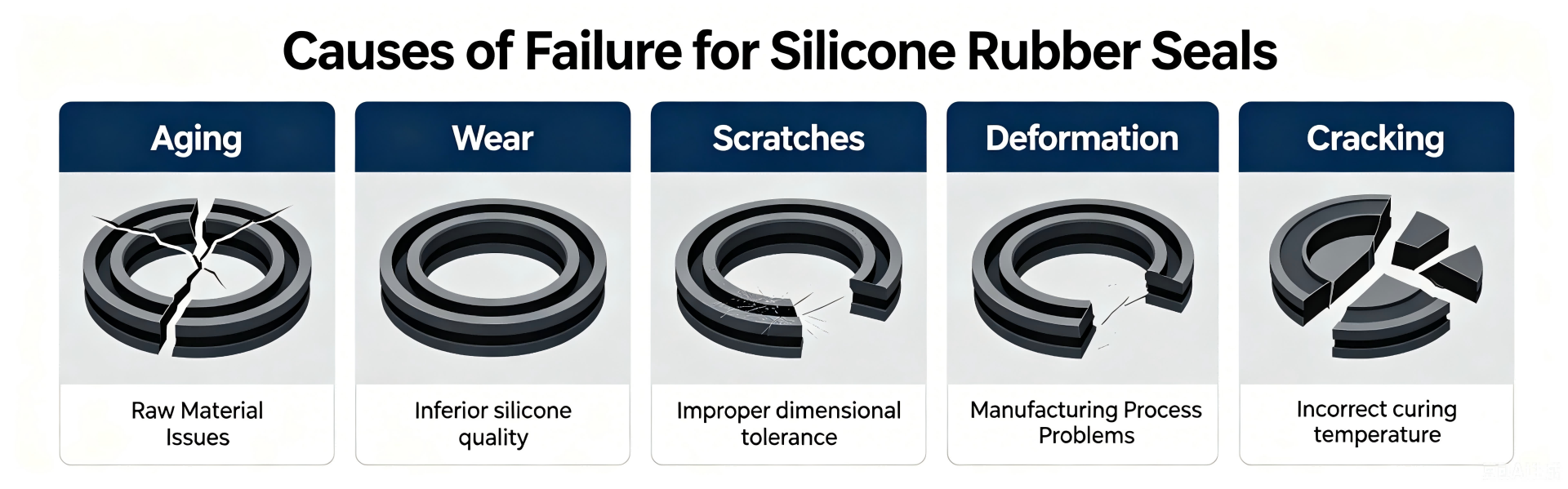
Rubber seals mainly fail in five forms: aging, wear, scratch, permanent deformation and cracking.
Aging Failure
Rubber aging failure is triggered by molecular degradation and excessive cross-linking of rubber polymers under complex working conditions. Typical aging symptoms of silicone rubber seals include surface cracking, hardening, brittleness, stickiness, discoloration, mildew and chalking. This defect will weaken insulation and sealing performance significantly, and different rubber grades present distinct aging failure characteristics.
Wear Failure
Rubber seal wear failure mainly occurs in dynamic sealing structures with frequent reciprocating motion. The friction causes uneven surfaces and continuous material loss of silicone rubber seals, forming tiny sealing gaps and eventually leading to leakage and seal failure.
Scratch, Deformation and Cracking
Surface scratches on rubber seals are mainly caused by improper assembly and hard medium impurities. Long-term static compression produces irreversible permanent deformation, while alternating stress and thermal cycling easily cause body cracking, which are common auxiliary failure modes of silicone rubber sealing parts.
Root Causes of Seal Failure
Raw Material Problems
Improper material selection: Unmatched silicone rubber grades fail to meet operational standards of temperature resistance, pressure resistance and medium resistance, which is a primary cause of rubber seal premature failure in industrial applications.
Poor rubber quality: Impurity contamination in rubber compounding or excessive additives reduces the mechanical properties and aging resistance of raw materials. Inferior rubber formulas directly cause potential silicone seal failure risks.
Structural Design Defects
The sealing capacity of silicone rubber seals relies on reasonable compression deformation. Unreasonable structural design is a key factor leading to frequent rubber seal failure.
Insufficient compression: Mismatched seal section size and oversized mounting grooves cause inadequate pre-compression, resulting in low-pressure medium leakage and sealing failure.
Excessive compression: A common defect in dynamic seal design. Excessive compression squeezes out interfacial lubricants, causing dry friction and accelerated rubber seal wear.
Medium incompatibility: When silicone rubber seals contact incompatible oil, acid, alkali or organic solvents, swelling, bulging and softening occur, completely losing sealing performance.
Mold and Processing Defects
Appearance defects: Unqualifiedrubber seal mold processing causes burrs, flashes and micro cracks on seal surfaces, forming leakage channels after assembly.
Dimensional inaccuracy: Low mold manufacturing precision leads to unqualified seal dimensions and abnormal compression, failing to meet standard sealing design requirements.
Internal defects: Uneven rubber mixing and poor exhaust in vulcanization produce internal bubbles and delamination inside seals, causing cracking and pressure leakage in service.
Why do we use it?
Lorem Ipsum is simply dummy text of the printing and typesetting industry. Lorem Ipsum has been the industry's standard dummy text ever since the 1500s, when an unknown printer took a galley of type and scrambled it to make a type specimen book. It has survived not only five centuries, but also the leap into electronic typesetting, remaining essentially unchanged. It was popularised in the 1960s with the release of Letraset sheets containing Lorem Ipsum passages, and more recently with desktop publishing software like Aldus PageMaker including versions of Lorem Ipsum.
Lorem Ipsum is simply dummy text of the printing and typesetting industry.
Lorem Ipsum is simply dummy text of the printing and typesetting industry.
Lorem Ipsum is simply dummy text of the printing and typesetting industry.
Lorem Ipsum is simply dummy text of the printing and typesetting industry.
Our Blog
LATEST NEWS
27 6 月
How to Select X-Rings | Professional X-Ring Sizing Guide
Choosing the proper X-Ring (star-shaped quad ring) for your sealing application follows these professional selection criteria:
1. Static Seals & Reciprocating Linear Motion
Bore-mounted (housing) seals
The inner diameter of the X-Ring should match the groove dimension, or be roughly 2% smaller than the outer diameter of the groove. The pre-compression creates stable pre-tension and effectively prevents X-Ring twisting during operation.
Shaft-mounted seals
The X-Ring inner diameter needs to equal or slightly exceed the shaft outer diameter by 0.2–0.3 mm, or 1% larger than the shaft OD. This design simplifies installation and extends the service life of the quad ring.
2. Rotary Shaft Sealing
For rotary applications, select an X-Ring whose inner diameter is 2%–5% larger than the shaft diameter.
Rubber X-Rings generate friction heat while rotating, which causes elastomer shrinkage. The enlarged inner diameter maintains proper lubrication and ensures reliable long-term sealing performance.
3. X-Ring Material & Standard Specifications
The most common material is NBR 70 Shore A (N70 nitrile rubber). You can also adopt other elastomer grades that match standard O-Ring material options.
X-Ring dimensions fully conform to universal O-Ring size standards.
27 6 月
NBR O-Ring Advantages & Disadvantages | Silicone Sealing Mold Manufacturing
When manufacturing silicone seal molds and rubber sealing products, NBR O-rings remain the most widely used sealing element. Let’s break down the main advantages and limitations of nitrile rubber O-rings.
Advantages of NBR O-Rings
- NBR O-rings deliver outstanding resistance to water, solvents and mineral oil, plus excellent air tightness for hydraulic and plumbing systems.
- Nitrile rubber features great wear resistance and reliable compression set performance under long-term clamping pressure.
Disadvantages of NBR O-Rings
- NBR seals cannot work well in polar chemical environments. They degrade quickly when exposed to ozone, ketones and other strong polar media.
About Our Precision Mold Factory
Since establishment, Dongguan Ouning Precision has adhered to the principle of premium quality and customer-oriented service, following ISO quality standards to continuously optimize mold precision. Our mold manufacturing has earned consistent recognition from global buyers.
We are equipped with imported CNC machining centers (Taiwan Dali 1020 / 860), KENT grinders, EDM machines, and Miyano (BNA-42C) CNC lathes from Japan. We also adopt Mitutoyo testing instruments and professional design software including UG, PROE, MASTERCAM and CAD. We provide one-stop service from product development to finished rubber seal mold fabrication.
Our core business covers custom molds for 45° X-rings & O-rings, oil shaft seals, valve stem seals, as well as Y-type, U-type, K-type, O-type and X-type high-precision silicone rubber sealing components.